For many Australian households, the kitchen table has become a high-stakes boardroom. As the 2026 academic year progresses, the hum of late-night study sessions and the rustle of practice exam papers have become the soundtrack of suburban life. While Year 10 serves as the critical gateway to senior secondary education, Year 12 remains the definitive “pressure cooker” for students aiming for specific ATAR (Australian Tertiary Admission Rank) targets.
However, a significant shift is occurring in how families approach these milestones. The traditional “grin and bear it” attitude is being replaced by a more nuanced, health-first strategy. According to recent data from the 2025 Mission Australia Youth Survey, nearly half of young Australians (46%) report experiencing moderate to high psychological distress, with “study pressure” consistently ranking as a top-three concern alongside cost-of-living and mental health.
The 2026 Landscape: Why the Pressure is Peaking
The Australian educational landscape has evolved. With the full implementation of updated curriculum standards across various states and a shifting job market that demands increasingly specialized STEM and digital skills, students feel the weight of “getting it right” earlier than ever. In Year 10, the pressure stems from subject selection—deciding between ATAR and VET pathways that seemingly dictate the rest of one’s life. By Year 12, the focus narrows to a singular number.
Families are now recognizing that this pressure isn’t just “part of growing up.” Leading educators suggest that the “information gain” required to excel in modern assessments often exceeds what a student can reasonably process without external support. This is why many proactive parents are turning to professional assignment help in australia to provide their children with the structural guidance and clarity needed to transform overwhelming tasks into manageable learning modules.
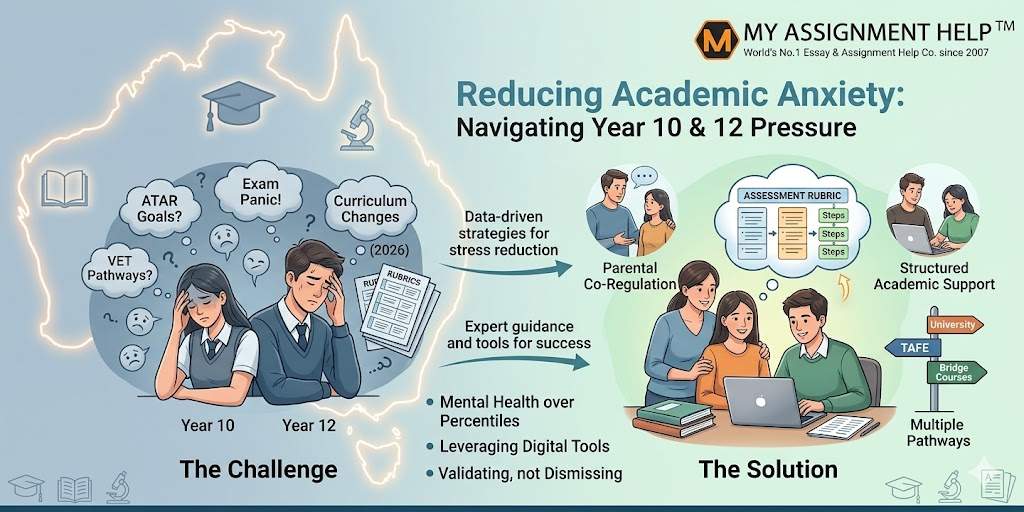
The “Co-Regulation” Strategy: How Families are Coping
In 2026, the most successful Australian families are adopting a “co-regulation” model. This involves parents not just as “taskmasters,” but as “emotional anchors.” Here is how they are navigating the storm:
- Prioritising Wellbeing over Percentiles: Recent longitudinal studies published in the Australian and New Zealand Journal of Public Health (2025) indicate that students who feel supported regardless of their grades actually perform better. Families are increasingly setting “hard stops” for study to ensure adequate sleep and physical activity.
- External Scaffolding: Recognizing that the “HSC/VCE/QCE” requirements are vastly different from what they experienced, parents are outsourcing the technical heavy lifting. Utilizing specialized assessment help australia allows students to see high-quality examples of what a “Grade A” report or analytical essay looks like, reducing the “blank page syndrome” that often triggers acute anxiety.
- Open Dialogue on “The Pivot”: Discussion around the “Plan B” is becoming standard. Knowing that there are multiple pathways into university (including diplomas and bridging courses) significantly lowers the cortisol levels in the home.
Key Takeaways for Parents
- Identify the “Distress Signals”: Look for changes in sleep patterns, social withdrawal, or uncharacteristic irritability.
- Validate, Don’t Dismiss: Avoid phrases like “It’s only a test.” Instead, use “I can see how much this matters to you; let’s look at how we can break this down.”
- Leverage Digital Tools: Use planners and reputable academic support services to manage the workload.
- Celebrate the Process: Focus on the effort put into a 2,000-word history inquiry rather than just the final mark on the portal.
The Anatomy of Academic Stress in 2026
- Primary Stressor: 52% of Aussie teens cite “School or Study” as their main source of stress.
- The “Anxiety Gap”: 1 in 5 students have missed school days due to mental health concerns related to assessments.
- The Support Shift: 44% of students now believe they can achieve their goals when supported by external academic resources.
FAQ Section
Q: Is Year 10 really as important as Year 12?
In 2026, Year 10 is the foundational year for the AQF (Australian Qualifications Framework). While it doesn’t count toward an ATAR, it determines the prerequisites for senior subjects. Establishing good study habits now is vital.
Q: How do I know if my child needs professional assessment help?
If your child is spending hours on a single task without progress, or if the “homework battle” is damaging your relationship, professional support can provide the necessary clarity and academic framework.
Q: What are the current ATAR trends in Australia?
There is a growing trend toward “early offers” based on Year 11 results and community involvement, though the final exams in Year 12 still remain the primary pathway for high-demand courses like Medicine and Law.
See also: Parenting Success Roadmap 2130392750 via Famousparenting.Com Insights
Author Bio
Lachlan Murray is a Senior Academic Consultant at MyAssignmentHelp.services. With over a decade of experience in the Australian secondary and tertiary education sectors, Lachlan specializes in developing content strategies that help students bridge the gap between classroom theory and high-distinction performance. He is an advocate for mental health in education and regularly contributes to discussions on the evolution of the Australian Curriculum.
References & Data Sources
- Mission Australia Youth Survey 2025: National Findings on Youth Mental Health.
- The Matilda Centre (University of Sydney): Longitudinal patterns of mental disorder symptoms in Australian adolescents (June 2025).
- Headspace National Youth Mental Health Foundation: 2026 Work and Study Month Report.
- Burnet Institute: Modelling the drivers of poor mental health in Australian teens (February 2026).